
Rebuilding Kala’s House

by Peter Collins

Kala’s story is very interesting, and it says more about Kala’s values and priorities than about the need to re-build her home. How did Kala, impoverished from birth, come to own a home in the first place?

Rewind 33+ years…..Kala was born in Kadayal, a little village in the extreme south of India.  She and her sister, Augustinal, lost their mother when they were two and seven years old.  They, along with their father, partially paralyzed due to a stroke, took shelter in the vestibule of the church.

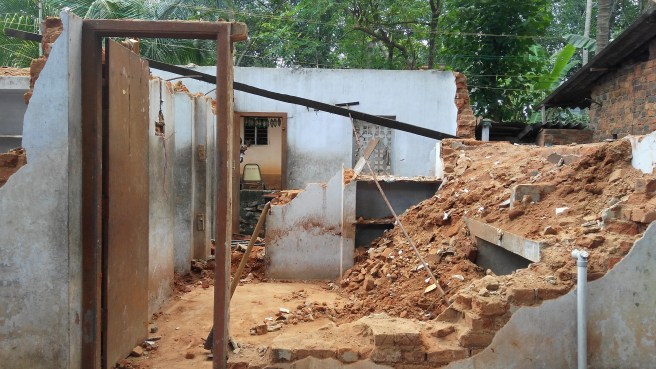
One day a man visiting from America was at Mass, and Kala’s father put her into his arms.  This was the start of a relationship of more than 30 years.  The American used his own money to build a fine brick house for the family.  This was their home for 25 years until a neighbor’s tree fell on the house and destroyed it.  Now the house is a pile of bricks and rubble.

This American brother in Christ had also solicited funds from a generous donor so that a house could be built for Augustinal and her girls, Deepthi Michael and Ashika Mikey.

To this day he has made monthly remittances out of his own income, and he has found others who generously give to Kala and her extended family every month.  These funds provide food, shelter, the education of children, and health needs.

When she was a young woman, Kala became a postulant in the order of the Franciscan Missionary Sisters in India. When she contracted tuberculosis, she had to leave the sisterhood.  Kala then went to Anna University, graduating with an MBA degree, but found that her TB and weak immune system prevented working.  Kala is now married, and she and her husband Kannan have adopted Sany Michael.

Kala and her family live in Chennai, the largest city in the state of Tamil Nadu, because there are employment opportunities there for Kannan.  However, they have wanted for many months to rebuild their house in Kadayal.

Earlier this year, the government announced a housing assistance program that offered seed money and reimbursement of building expenses to people who could demonstrate clear title to land and wanted to build or improve their houses. The Indian government has many stipulations and regulations that Kala and Kannan are trying to meet, including the need to demonstrate consistent progress.  To date, they have spent $2,000 on the foundation, and they need another $10,000 to rebuild the walls and qualify for further government assistance.

Kala has reached out to Barnabas for help.  We raised over $1000 for this project, but Kala requested that we reappropriate the funds toward Catholic school tuition for her two nieces, Augustinal’s daughters. The donors to Barnabas agreed that education was a better use of the money than rebuilding the house.  For folks at the bottom of the economic ladder in India, education is the only path out of poverty, because with education jobs are open to them.

Kala’s remarkable trust in the Lord’s providence is an inspiration to all.  If Barnabas donors can respond soon, she and Kannan can qualify for money for house building before a government deadline of December 10.  Can you help Kala take the next steps to rebuild her home?

Medical Supplies to Puerto Rico for Disaster Relief

On September 20th, 2017, hurricane Maria, a powerful, category-4 storm, passed through Puerto Rico and left a trail of devastation and destruction.  It was the most damaging hurricane to hit Puerto Rico in over 80 years.  With infrastructure already suffering from years of neglect and the recent passing of hurricane Irma just north of the island, this atmospheric event was certainly unwelcome and untimely.  With all imports depending on the air and the sea, the road to recovery has been slow and filled with struggles.

Thanks to God and His Providence, Puerto Ricans, living outside the island and other people of good will, have begun to do whatever can be done with whatever resources are available at their disposal to provide relief. Barnabas Almsgiving Fund is accepting donations to help provide medical supplies and medications to hospitals, especially in remote mountainous areas.

Puerto Rico

Disaster related diseases such as leptospirosis have created an epidemic claiming lives. Much effort is ongoing to control outbreaks.  Donations are also providing pediatric medical equipment to help affected children.

As supplies are gathered, they are sent using whatever shipping channels become available.  Through local connections in Oakland County, we have been able to take advantage of offers to transport supplies at no cost and deliver them to trusted contacts.  If these generous offers continue in the future, we will continue to use as a means at getting supplies shipped at no charge. Otherwise, we will use logistics companies such as UPS and/or FedEx to deliver supplies as economically as possible.

Once the emergency in Puerto Rico is relieved, we will consider diversifying to provide medical supplies and medications to different medical missions around the world.

Donations are being accepted through ConnectNow.  Please consider supporting this important cause.

Putting Our Treasure In Its Place

by Dr. Ralph Martin

I’d like to share a bit of my personal testimony with you.  When my wife and I got married, I only had a part-time job. I was digging sewer lines in Williamston, Michigan, and then we got hired at St. Mary’s Chapel, but not at a very high wage. My wife was a lab tech, but we were pregnant with our first baby and she was going to have to stop work, and we were wondering how this was going to work.

One day on her way home from the hospital, my wife stopped at the chapel and said, “I’m not leaving, Lord, until You let me know whether this is going to work out or not.”

I was back in our one-bedroom apartment praying the same prayer—“Lord, help, what is going to happen?”

I had this absolutely strong experience of God saying,

“I’m your Father; you can rely on Me.

You can trust Me.”

My wife got the same sense, so she came home and told me what she experienced, and I told her what I experienced. We didn’t know how it was all going to work, but we knew the Lord had assured us of His care.

Later, I remember praying on the floor of our apartment, which had hardly any furniture. I felt like the Lord told me, “I am going to give you a Scripture passage that you need to make the key Scripture passage of your life.”

It was Luke 12:28-31: “Unbelievers are always worried about what they’re going to eat, what they’re going to wear, what the future’s going to bring, and I say to you, seek first the kingdom of God and his holiness and these other things will be added as well, because your heavenly father knows you need them.”

This is not the prosperity Gospel. This is not the promise of getting a Cadillac or a Mercedes. This is a promise that God the Father is going to give us what we need to carry out the mission for which He created us.

I can’t tell you enough how important it is to take seriously these words of Jesus: “Seek first the kingdom of God and His holiness, and these other things will be added as well.”

If you put the first things in the first place, the second things are going to work out really well. If you try to put a second thing in the first place, there’s going to be tremendous strain and frustration, and it’s not going to work.

Let me tell you how my wife and I started to deal with the question of tithing. In the Old Testament, you had to give the first ten percent of your income, of the produce of your fields, to the Lord. It is not a requirement in the New Testament.

But in the New Testament, an even greater price has been paid for us; a greater deed has been done for us—Jesus’ death on the cross—so generous giving is encouraged.

When my wife and I got married, we had few worldly possessions. We shared one very used car with three other couples. We didn’t have a lot, but we started tithing—giving ten percent, with half for the parishes we attended, half for causes we believed in, and then giving alms. We were just trying to pass on what the Lord was giving to us, and that has been our practice for over forty years.

Sometimes in the early days, when we’d be serving meals, we’d be concerned about not having enough food—and honestly, the food was multiplying!

How is this possible? It’s knowing the Father’s love. It’s gratitude for Jesus’ sacrifice and wanting to follow His teaching.

Jesus says, “Do not be afraid any longer little flock, for your Father is pleased to give you the kingdom. Sell your belongings and give alms. Provide moneybags for yourself that do not wear out—an inexhaustible treasure in heaven that no thief can reach nor moth destroy, for where your treasure is so also will your heart be” (Lk 12:32-34).

St. Francis DeSales has tremendous wisdom about how to make this concrete: How do you know you’re not fooling yourself about your relationship to money? How do you know you’re letting Jesus really be Lord of your finances? He talks about some of the ways we can deceive ourselves in this area and some practical steps we can take to keep turning this area over to the Lord.

The first thing he says is waiting until you have enough is a delusion. You’re never going to feel like you have enough. He says start where you are, being generous with what you have. The second thing he recommends is asking yourself what happens when you lose money.

Do you freak out? Do you feel like the end of the world has come? What happens to your heart? Are you so attached to money that it’s disturbing your whole life—or can you move beyond it, trusting that the Lord will provide?

He says if you find your heart very desolated and afflicted at the loss of money, you love it too much. The strongest proof of love for a lost object is suffering over its loss. Instead, accept your losses meekly, patiently, and avail yourself of the opportunity to live more simply. The Apostle Paul said, “I know how to handle the want and I know how to handle abundance. I know how to abase and I know how to abound” (Phil 4:12).

We need to have a certain detachment and freedom about leaving our money in God’s hands. Talking about disciples, St. Catherine of Sienna said, “The Lord gives a lot of money to people He knows can handle it well. And if He’s not giving you a lot of money, maybe it’s for the good of your soul, maybe He knows you couldn’t handle it well.”

Scripture also has advice to people who are wealthy: “Tell those who are rich in this world’s goods not to be proud, and not to rely on so uncertain a thing as wealth. Let them trust in the God who provides us richly with all things for our use. Charge them to do good, to be rich in good works, and generously sharing what they have, thus they will build a secure foundation for the future, for receiving that life which is life indeed” (1 Tm 6).

You can’t outdo the Lord in generosity. I can’t tell you how much the Lord has blessed us like He says He will bless those who follow Him. I’d recommend if you’re not already tithing to start doing it, even if you hardly have any money, and see what the Lord will do.

Dr. Ralph Martin is the President of Renewal Ministries and the Director of Programs of Evangelization at Sacred Heart Major Seminary.  This article is excerpted from Renewal Ministries Newsletter (Nov 2016) and used with permission.

Meet Liffy, Medical Student, Trinity School of Medicine, Grenadines

Seven years ago, while on a mission trip in India with the Sisters of the Sacred Heart of Jesus, Alan Hannibal, a BAF supporter, met Liffy and her brother Michael.  They lived with their parents just a few blocks from the SSHJ Motherhouse in Vellore, Tamil Nadu, India.
James, Liffy’s father works at the Motherhouse caring for the livestock. Michael and Liffy are often visiting there as they have many friends among the Sisters.

Unfortunately, James, their father, suffers from many health problems and has never been able to financially support the family.  They are very poor and have few possessions.

Michael and Liffy are very bright.  From the first time they met, Liffy expressed a strong desire to become a doctor and care for her people.  In India, unless you are in the top 2 or 3 percent of the students graduating from high school, there is no chance of getting a seat in medical school—that is unless you are very, very rich. Unlike medical school in the USA, students in India start medical school immediately following high school, but Leffy did not qualify.

Since medical school was out of reach, Liffy’s family, wanted her to become an engineer.  However, Liffy had her heart set on becoming a doctor.  Alan and his wife Kathie not only supported her dream, they also decided to support her dream financially.  To this end, they suggested she take a medically aligned curriculum in college so that she could potentially come to the USA and attend medical school.  Their hope was for her to attend Lake Erie College of Medicine (LECOM), which is located in Erie, PA near Alan and Kathie’s home.

Liffy applied and was accepted at Vellore Institute of Technology (VIT) in Biotechnology–a five-year Master’s Program.  Her fifth year was spent with Kathie and Alan in Erie, PA at Gannon University where Liffy completed her Master’s thesis on the study of bacteria in Lake Erie.

She graduated from VIT this past June.   Unfortunately, she was not accepted at LECOM because they do not accept international students unless they have studied in the US for at least two years.  Liffy was accepted at Trinity School of Medicine, St. Vincent in the Grenadines.

Liffy began her studies on September 4th, 2017.  Her first two years will be at Trinity, then two years of clinical studies in the US.  Finally, she will complete three or four additional years as a Resident in a US hospital.  She has already been issued a ten year VISA for entering the US as a visitor or as a student.

Upon completion of her medical degree, Liffy is committed to returning to India to serve the medical needs of the Indian people, particularly the poor.

First John 3:16 and Almsgiving

by Peter Williamson

The most famous verse in the New Testament is John 3:16, and with good reason. It sums up the gospel in a few words.  However, very few Christians are familiar with First John 3:16, which sums up the ethical implications of the gospel for our relationships: “By this we know love, that he laid down his life for us, and we ought to lay down our lives for the brothers.” In other words, Jesus showed his love by dying on the cross for us.  We are called to “love one another just as [he] has loved [us]” (John 13:34; 15:12), so this means laying down our lives for the brothers and sisters, just as he did.

But what does this mean?  Very few of us will be given the opportunity to literally die for another person, although we must be ready to do so if the circumstances call for it.  What does it mean for the rest of us to lay down our lives for our brothers?  The next verse tell us in very specific terms by critiquing the opposite conduct: “But if anyone has the world’s goods and sees his brother in need, yet closes his heart against him, how does God’s love abide in him?” (1 John 3:17).

I recently witnessed an example of love for the brothers and sisters on the part of someone whom Barnabas is trying to help.  An Indian woman named Kala is trying to rebuild her house after a tree fell during a storm and destroyed it. (See photo).

Vellore India

Kala needs about $8000 to complete the project, but Barnabas has only been able to raise $1000 so far.  Two weeks ago she asked permission to redirect the $1000 sent for her house to instead be used to pay the tuition of three children who otherwise would not be able to attend school (see Gift of Education).  Permission was granted, but with the hope that Kala’s house fund can be reimbursed from other donations toward education needs.

If God’s love has come to live in us, we will want to share our material resources with our brothers and sisters in need.  If we don’t share our stuff, it is doubtful whether we have the God’s love in us, whether we are really Christians!  The Letter of James makes a similar point, questioning whether a person who fails to give food or clothing to a needy brother or sister has the kind of faith that can save them (see James 2:14-17).

These verses have profoundly shaped my understanding of what it means to live as a Christian.  Love is not simply being friendly toward people or having good intentions: it must be expressed concretely in acts of sharing money and possessions with those in need, in other words, almsgiving.

That insight immediately raises some hard questions:  Who are the brothers and sisters whose needs I “see” and am obliged to help meet?  Fellow Christians, for sure, but does it stop there?  Also, does this teaching have any limits?  The needs of even my fellow Christians in my home town of Ypsilanti, Michigan, exceed my financial resources, not to mention the needs of those in Sudan or India.  Where should I give, and how much?  Mother Theresa and Francis of Assisi gave everything away that exceeded what the poor who surrounded them possessed.  Were they wrong?  How should my faith and love be expressed in material sharing with the needy?

Those are hard questions and I will reflect on them in the next couple blogs.  One thing is clear: to live as a Christian in faith and love requires that I share material resources generously with those whose needs I know.  The concluding verse of the paragraph that begins with First John 3:16 says it well: “Little children, let us not love in word or talk but in deed and in truth” (1 John 3:18).

How can we find the generosity and faith to do this? A little later in his letter John explains: “We love because he first loved us” (1 John 4:19). The love of God expressed in Jesus’ voluntary death on the cross for us, and in God’s love poured into our hearts by the Holy Spirit (Rom 5:4), is the entire basis of our ability to share.

Gift a Child a Future Through Education

by Peter Collins

Educate a child in India. Your gift will put a child on the road to self-sufficiency, while surrounded by the love of God, and immersed in Catholic tradition through the Sisters of the Sacred Heart of Jesus.

Education is one of India’s most pressing challenges. Half of India’s 1.2 billion people are age 25 or younger, and literacy levels, while improving, could cripple the country’s long-term prospects.

Through Barnabas’s support of the work of the Sisters of the Sacred Heart of Jesus, we have accepted the challenge to fund the private education of 21 children.  This challenge flows from our Mission Statement.

The children of the very poor—families at the bottom of the ladder—have scant chance of escaping the struggle of poverty and to live as their parents.  And if a woman is widowed, or separated from an abusive relationship, she lives by the charity of relatives and neighbors, because she has no means of income.  Her children most certainly will have the same life. Together we can attempt to break this cycle.

One possibility—some say the only possibility—of escaping a family’s poverty is through education.  Through education a child in poverty has the possibility of becoming literate in language and mathematics, the basic skills needed in nearly all jobs.

So, we appeal to you to prayerfully reflect on this need, and to donate as you wish. We need $350 per year to cover the cost of elementary and high school tuition, books, supplies, and required uniforms.  This is an impossible amount for poor Indian families, but very possible for many of us.  Only through your generosity can this mission be accomplished, one child at a time.

We appreciate your consideration of this challenge and your interest in the work of Barnabas.

Giving and Receiving

by Peter Williamson

If I give more, will I receive more? It may scandalize you, but the answer of Scripture is a clear “Yes!”

Most of us have had some exposure to the “Prosperity Gospel” through TV evangelists who ask for donations with promises seem too materialistic or that even appeal to selfishness.  But these evangelists are not all wrong.  Listen to Jesus’ words from Luke 6:38: “Give, and it will be given to you. A good measure, pressed down, shaken together and running over, will be poured into your lap. For with the measure you use, it will be measured to you.”

Jesus was not the first to express this teaching. Many centuries earlier Proverbs taught that a generous person will be enriched, while greed and stinginess have negative consequences (Prov 11:24-25; 28:27). According to Gary Anderson, an Old Testament scholar, for ancient Israel this was not merely a matter of morals but of metaphysics, it was how the world works.  Other Old Testament texts teach that the Lord directly rewards generosity: “He who is kind to the poor lends to the LORD, and he will repay him for his deed” (Prov 19:17).

The apostle Paul emphasizes that there is a direct relationship between what we give and what we will receive from God: “Whoever sows sparingly will also reap sparingly, and whoever sows generously will also reap generously” (2 Cor 9:6).  A few verses later he emphasizes God’s ability and desire to reward generosity and assures his readers of ample provision.

And God is able to make all grace abound to you, so that in all things at all times, having all that you need, you will abound in every good work….  Now he who supplies seed to the sower and bread for food will also supply and increase your store of seed and will enlarge the harvest of your righteousness.  You will be made rich in every way so that you can be generous on every occasion…. (2 Cor 9:8-11)

Of course, some qualifications are necessary. No one can bribe God by giving generously while disobeying his commandments and expect his blessing. Some in ancient Israel tried this and the results weren’t pretty (see Isa 1:11-17). Also, while there are rewards in this life, they don’t eliminate suffering.  Jesus promises to those who renounce everything to follow him “a hundredfold now in this time, houses and brothers and sisters and mothers and children and lands, with persecutions, and in the age to come eternal life” (Mark 10:30).  Rich blessings plus persecutions!

That verse reminds us that the true reward for generosity is not wealth in this life, but rather eternal life. A few verses earlier Jesus invited a rich young man to radical generosity with just such a promise: Mark 10:21  “You lack one thing: go, sell all that you have and give to the poor, and you will have treasure in heaven; and come, follow me.”

I would like to conclude with a word of testimony.  I come from a family of three generations of missionaries and ministers.  All tithed their incomes; all trusted in God for their provision; all gave generously; and all never lacked what they needed.  Along with many friends, I also have sought to do the same: to tithe, to give alms as generously as possible; we also have seen God’s consistent blessing.  Generous giving may not be a path to getting rich in this world, but it is a path to rich living, to experiencing God’s blessing and provision, both here and now, and, I firmly believe, in the life to come.

Almsgiving and the Gospel

by Peter Williamson

Lent has come ‘round once again and we are reminded that Jesus says “when you give alms…, when you fast…, when you pray” (Matt 6:3-6, 16-18).  These are the practices he expects will characterize his disciples.  Why?

My focus in this brief article is the relationship between almsgiving and the gospel.  At first glance, it would seem that there is no particular relationship, since almsgiving is already taught in the Old Testament (e.g., Deut 15:7-11; Prov 19:17; 31:20) and is practiced by Jews, Muslims, adherents of other religions, and even many atheists.  It would seem that giving to the needy is universally recognized as virtuous, even obligatory in cases of urgent need.  We Christians can celebrate this common ground with people of all beliefs, especially with the Jewish people, since like them, we draw upon the rich teaching of the Old Testament about almsgiving.

The difference that the gospel makes has everything to do with Jesus.  First, Jesus teaches a more radical message about almsgiving than anyone did before him.  He doesn’t just say give of your excess income. He says, “Sell your possessions and give alms” that you may possess “an unfailing treasure in heaven” (Luke 12:33).  He insists that all his disciples renounce all their possessions (Luke 14:33; 18:22), says that it is more blessed to give than to receive (Acts 20:35), and points out in parables the tragic end of those who take good care of themselves but neglect care of the poor (Luke 12:15-21; 16:19-25; Matt 25:21-46).

What really distinguishes gospel almsgiving, however, is what Jesus does rather than what he teaches. Here’s the story we read in the Bible:  Jesus hunts down the poorest family he can find,—Adam’s descendants, an absolutely destitute family, caught in an endless cycle of generational poverty, addiction and crime—a hopeless situation, worse than any inner-city family you’ve heard about.  What he does next will take your breath away.  He takes his infinite wealth, including his beautiful home in heaven, and gives it to this poor family, trading residences and life circumstances with each member, taking on all their poverty, and giving to each of them the power become children of God, to leave their poverty behind and to share his Father’s wealth.  One member of that poor family put it this way:

“For you know the grace of our Lord Jesus Christ, that though he was rich, yet for your sakes he became poor, so that you through his poverty might become rich” (2 Cor 8:9).

What motivated Jesus’ almsgiving? “the Son of God… loved me and gave himself for me” (Gal 2:20)

Just as Christians are capable of forgiving, because we’ve been forgiven, we are capable of giving alms generously because we are the beneficiaries of Jesus’ matchless generosity.  That’s the secret of the joyous giving of St. Paul, St. Francis, John Wesley, Mother Theresa, Rick Warren, Tom Monaghan, and Heidi Baker to name only a few.

This Lent let’s remember the alms Christ has given us and joyfully pass on to others as much as we are able!