
Meet Liffy, Medical Student, Trinity School of Medicine, Grenadines

Seven years ago, while on a mission trip in India with the Sisters of the Sacred Heart of Jesus, Alan Hannibal, a BAF supporter, met Liffy and her brother Michael.  They lived with their parents just a few blocks from the SSHJ Motherhouse in Vellore, Tamil Nadu, India.

James, Liffy’s father works at the Motherhouse caring for the livestock. Michael and Liffy are often visiting there as they have many friends among the Sisters.

Unfortunately, James, their father, suffers from many health problems and has never been able to financially support the family.  They are very poor and have few possessions.

Michael and Liffy are very bright.  From the first time they met, Liffy expressed a strong desire to become a doctor and care for her people.  In India, unless you are in the top 2 or 3 percent of the students graduating from high school, there is no chance of getting a seat in medical school—that is unless you are very, very rich. Unlike medical school in the USA, students in India start medical school immediately following high school, but Leffy did not qualify.

Since medical school was out of reach, Liffy’s family, wanted her to become an engineer.  However, Liffy had her heart set on becoming a doctor.  Alan and his wife Kathie not only supported her dream, they also decided to support her dream financially.  To this end, they suggested she take a medically aligned curriculum in college so that she could potentially come to the USA and attend medical school.  Their hope was for her to attend Lake Erie College of Medicine (LECOM), which is located in Erie, PA near Alan and Kathie’s home.

Liffy applied and was accepted at Vellore Institute of Technology (VIT) in Biotechnology–a five-year Master’s Program.  Her fifth year was spent with Kathie and Alan in Erie, PA at Gannon University where Liffy completed her Master’s thesis on the study of bacteria in Lake Erie.

She graduated from VIT this past June.   Unfortunately, she was not accepted at LECOM because they do not accept international students unless they have studied in the US for at least two years.  Liffy was accepted at Trinity School of Medicine, St. Vincent in the Grenadines.

Liffy began her studies on September 4th, 2017.  Her first two years will be at Trinity, then two years of clinical studies in the US.  Finally, she will complete three or four additional years as a Resident in a US hospital.  She has already been issued a ten year VISA for entering the US as a visitor or as a student.

Upon completion of her medical degree, Liffy is committed to returning to India to serve the medical needs of the Indian people, particularly the poor.
First John 3:16 and Almsgiving

by Peter Williamson

The most famous verse in the New Testament is John 3:16, and with good reason. It sums up the gospel in a few words.  However, very few Christians are familiar with First John 3:16, which sums up the ethical implications of the gospel for our relationships: “By this we know love, that he laid down his life for us, and we ought to lay down our lives for the brothers.” In other words, Jesus showed his love by dying on the cross for us.  We are called to “love one another just as [he] has loved [us]” (John 13:34; 15:12), so this means laying down our lives for the brothers and sisters, just as he did.

But what does this mean?  Very few of us will be given the opportunity to literally die for another person, although we must be ready to do so if the circumstances call for it.  What does it mean for the rest of us to lay down our lives for our brothers?  The next verse tell us in very specific terms by critiquing the opposite conduct: “But if anyone has the world’s goods and sees his brother in need, yet closes his heart against him, how does God’s love abide in him?” (1 John 3:17).

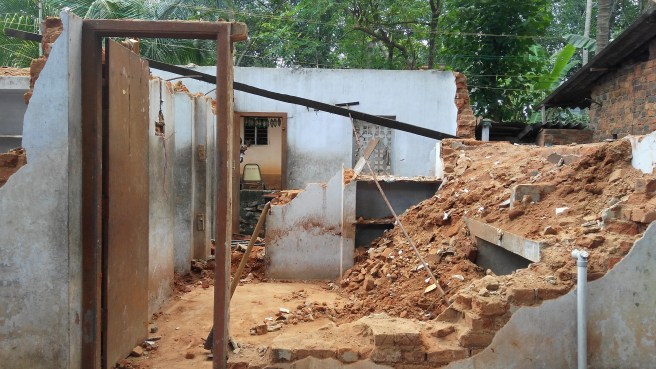
I recently witnessed an example of love for the brothers and sisters on the part of someone whom Barnabas is trying to help.  An Indian woman named Kala is trying to rebuild her house after a tree fell during a storm and destroyed it. (See photo).

Vellore India

Kala needs about $8000 to complete the project, but Barnabas has only been able to raise $1000 so far.  Two weeks ago she asked permission to redirect the $1000 sent for her house to instead be used to pay the tuition of three children who otherwise would not be able to attend school (see Gift of Education).  Permission was granted, but with the hope that Kala’s house fund can be reimbursed from other donations toward education needs.

If God’s love has come to live in us, we will want to share our material resources with our brothers and sisters in need.  If we don’t share our stuff, it is doubtful whether we have the God’s love in us, whether we are really Christians!  The Letter of James makes a similar point, questioning whether a person who fails to give food or clothing to a needy brother or sister has the kind of faith that can save them (see James 2:14-17).

These verses have profoundly shaped my understanding of what it means to live as a Christian.  Love is not simply being friendly toward people or having good intentions: it must be expressed concretely in acts of sharing money and possessions with those in need, in other words, almsgiving.

That insight immediately raises some hard questions:  Who are the brothers and sisters whose needs I “see” and am obliged to help meet?  Fellow Christians, for sure, but does it stop there?  Also, does this teaching have any limits?  The needs of even my fellow Christians in my home town of Ypsilanti, Michigan, exceed my financial resources, not to mention the needs of those in Sudan or India.  Where should I give, and how much?  Mother Theresa and Francis of Assisi gave everything away that exceeded what the poor who surrounded them possessed.  Were they wrong?  How should my faith and love be expressed in material sharing with the needy?

Those are hard questions and I will reflect on them in the next couple blogs.  One thing is clear: to live as a Christian in faith and love requires that I share material resources generously with those whose needs I know.  The concluding verse of the paragraph that begins with First John 3:16 says it well: “Little children, let us not love in word or talk but in deed and in truth” (1 John 3:18).

How can we find the generosity and faith to do this? A little later in his letter John explains: “We love because he first loved us” (1 John 4:19). The love of God expressed in Jesus’ voluntary death on the cross for us, and in God’s love poured into our hearts by the Holy Spirit (Rom 5:4), is the entire basis of our ability to share.